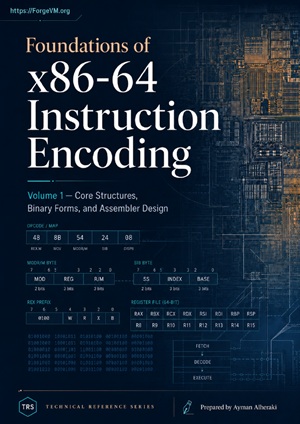
The Comprehensive Reference Index for Intel x86-64 Instructions
A concise guide to the evolution of Intel x86-64 instructions, from the original 8086 through IA-32 and Intel 64 to SSE, AVX, AVX2, AVX-512, AMX, APX, and AVX10. It organizes major instruction families by purpose, generation, cautions, and practical NASM examples, providing learners and low-level programmers with a clear map before consulting Intel’s official manuals.
About this book
The Intel x86-64 instruction set is far more than a collection of assembly mnemonics. It represents nearly five decades of architectural evolution, beginning with the 8086 and expanding through IA-32, Intel 64, SIMD extensions, cryptographic acceleration, virtualization, system programming, wide-vector processing, matrix acceleration, and newer technologies such as Intel APX and AVX10.
**The Comprehensive Reference Index for Intel x86-64 Instructions** is designed as a structured educational map of this vast instruction-set architecture. Its purpose is to help learners, assembly programmers, systems developers, compiler engineers, reverse engineers, and performance specialists understand how the major instruction families relate to one another before consulting the much larger official Intel manuals.
The book follows the architecture historically and logically, beginning with the fundamental 8086 instruction families—data movement, arithmetic, logic, branching, stack operations, procedures, strings, flags, and processor control. It then progresses through 32-bit IA-32 and the transition to Intel 64, including 64-bit registers, addressing, RIP-relative operations, and modern execution modes.
Later sections organize the major extension families, including:
* x87 floating-point instructions;
* MMX and early packed-data processing;
* SSE, SSE2, SSE3, SSSE3, SSE4.1, and SSE4.2;
* AVX and AVX2;
* AVX-512 and its masking and specialized subsets;
* cryptographic and security-related instructions;
* bit manipulation and specialized integer extensions;
* cache, memory-ordering, synchronization, and atomic operations;
* privileged and system instructions;
* virtualization facilities;
* Intel AMX matrix and tile instructions;
* Intel APX general-purpose architectural extensions;
* Intel AVX10 vector architecture.
For each major group, the reader is given its architectural context, intended purpose, processor generation or extension, important cautions, and simple NASM-oriented examples where appropriate.
The recommended learning path is:
**Registers and Flags → 8086 Core → IA-32 → Intel 64 → SSE2 → AVX2 → AVX-512 → AMX → APX → AVX10**
This progression helps readers understand not only *what* an instruction does, but also *where it belongs in the evolution of x86-64*.
### Important Methodological Note
This book is an educational reference index, not a replacement for the **Intel Software Developer’s Manual**. Exact opcode encodings, instruction exceptions, privilege requirements, valid processor modes, CPUID feature detection, operand restrictions, latency and throughput characteristics, and possible exceptions such as `#UD` or `#GP` must always be verified in Intel’s official documentation.
The purpose of this book is therefore simple:
**to turn the enormous Intel x86-64 instruction-set landscape into a readable, structured, and practical map for learning and quick reference.**
The PDF is not exposed as a public static URL. The download endpoint validates the catalog record, updates statistics, then streams the file.