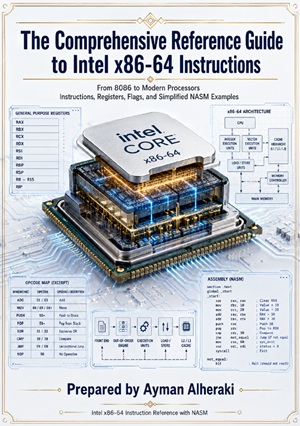
x86-64 Appendices, Tools, and Developer Resources
Volume 6 is a practical companion for x86-64 developers, covering NASM, GNU, LLVM, Intel XED, ELF64, PE/COFF, and Mach-O. It focuses on inspection, debugging, validation, automation, golden tests, fuzzing, CI, troubleshooting, and long-term maintenance of assemblers, compilers, JITs, disassemblers, and binary tools.
About this book
**x86-64 Appendices, Tools, and Developer Resources — Volume 6** is the practical engineering companion to the x86-64 Technical Reference Series, focusing on the tools, workflows, validation techniques, binary formats, troubleshooting methods, and maintenance practices required to turn instruction-encoding knowledge into dependable low-level software.
While the earlier volumes concentrate on instruction encoding, assembler architecture, and reference tables, this volume addresses an equally important question: **how can developers inspect, test, validate, debug, automate, and maintain an x86-64 implementation over time?**
The book brings together the essential toolchains used throughout modern x86-64 development, including **NASM, GNU assembler and binutils, LLVM tools, and Intel XED**. Rather than treating these utilities as isolated programs, the volume demonstrates their roles within a practical verification workflow for assemblers, disassemblers, compilers, JIT engines, virtual machines, and binary-analysis systems.
A central theme is **independent validation**. Correct-looking machine code is not sufficient evidence that an encoder is correct. Generated instructions should be compared against trusted implementations, decoded independently, executed where appropriate, and tested systematically. The volume therefore explores techniques such as:
**assemble → inspect → disassemble → compare → execute/test → automate**
Binary inspection forms another major part of the book. Developers are introduced to workflows for examining machine code, sections, symbols, relocations, addresses, and other executable structures across the principal native binary ecosystems: **ELF64, PE/COFF, and Mach-O**. This connects instruction-level encoding with the larger environment in which generated code is stored, linked, loaded, and executed.
The volume gives particular attention to **debugging and troubleshooting**. Encoding errors can originate from incorrect prefixes, operand sizes, ModR/M or SIB fields, displacements, immediates, relocations, instruction selection, feature assumptions, or object-file construction. A structured diagnostic workflow helps developers isolate these problems rather than relying on trial and error.
Testing is treated as part of the architecture itself. The book discusses **golden tests, regression suites, differential testing, round-trip encode/decode verification, fuzzing, malformed-input testing, continuous integration, and automated cross-tool comparisons**. These methods are especially valuable for x86-64 because its large and historically layered instruction set creates an enormous number of valid and invalid combinations.
Automation extends these techniques from individual experiments into repeatable engineering processes. Scripts and CI pipelines can continuously assemble reference cases, compare emitted bytes, inspect generated object files, execute validation suites, and detect regressions as an assembler or binary tool evolves.
The book also addresses **long-term maintenance**. x86-64 is not a static architecture: new instruction extensions, encoding forms, processor features, toolchain versions, and documentation revisions continue to appear. A sustainable implementation therefore requires versioned instruction data, reproducible tests, carefully maintained references, and procedures for incorporating architectural changes without destabilizing existing functionality.
The appendices consolidate useful developer resources and provide practical guidance for navigating authoritative architecture manuals, tool documentation, instruction databases, binary-format specifications, and verification utilities. The objective is not to replace those primary sources, but to show how they can be combined effectively during real implementation work.
Together with **Volumes 1–5**, Volume 6 completes the series by moving from architectural understanding to **engineering confidence**. It provides the inspection, debugging, validation, automation, troubleshooting, and maintenance practices needed to keep an x86-64 assembler, compiler backend, JIT, disassembler, virtual machine, or binary tool correct and maintainable throughout its development lifecycle.
**Prepared by Ayman Alheraki for the ForgeVM Technical Reference Series.**
The PDF is not exposed as a public static URL. The download endpoint validates the catalog record, updates statistics, then streams the file.